

01 Oct Chikushin Shakuhachi: Built to Perform at the Pinnacle of Traditional Craftsmanship
The shakuhachi is more than a musical instrument—it is a vessel of history, spirituality, and artistry that has resonated through centuries of Japanese culture. At Chikushin Shakuhachi, I dedicate myself to preserving this heritage through the craft of instrument-making, guided by the traditions passed down by masters of the art.
A Legacy Rooted in Japanese Tradition
The shakuhachi traces its origins back to the 8th century, when it was introduced to Japan from China and gradually developed into a uniquely Japanese instrument. Over time, it became deeply entwined with Zen Buddhist practice, used not merely for music but as a tool for meditation and spiritual cultivation. The haunting tones of the shakuhachi are said to mirror the breath of life itself, embodying both impermanence and presence.
Crafting shakuhachi is a way to continue this lineage. Each flute I make is an offering to this centuries-old tradition, shaped by respect for its cultural and spiritual significance.
Honoring Traditional Craftsmanship
Every Chikushin Shakuhachi is made from madake, a high-quality bamboo harvested in Japan. This natural material is carefully selected for its density, resonance, and character. From the moment I began my journey into shakuhachi making in 2003, I understood that true artistry lies not in shortcuts but in fidelity to time-honored methods.
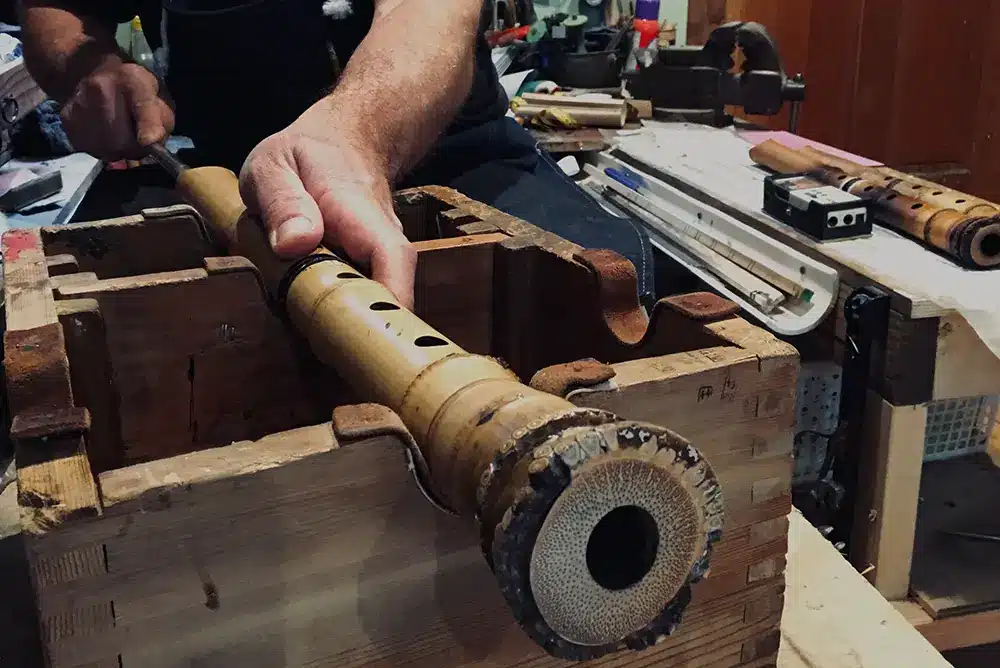
The crafting process is meticulous: splitting and seasoning the bamboo, shaping the bore with precision, and forming the utaguchi—the mouthpiece—at a precise angle and depth. The slightest variation in these details alters the instrument’s voice. A properly shaped utaguchi, combined with an exact inner bore, ensures that the flute produces a pure, balanced tone that allows the player to express the full spectrum of emotion and nuance.
Guidance from Japanese Masters
My path as a maker was shaped by invaluable mentorship. I studied under Bill Shozan Schultz and Riley Lee in Los Angeles. I later traveled regularly to Japan to refine my craft with esteemed teachers, including Kaoru Kakizaki, Takahashi Toyomi, John Kaizan Neptune, and Shingo Kimura. Their teachings instilled in me the importance of patience, discipline, and the pursuit of excellence, values that guide every instrument I create.
Jiari and Jinashi: Two Traditions in Harmony
Chikushin Shakuhachi are available in both jiari and jinashi forms, each embodying a distinct aspect of the instrument’s tradition.
- Jiari shakuhachi are carefully shaped with an inner layer of ji (a natural paste) to achieve precise intonation and projection, making them ideal for professional performance.
- Jinashi shakuhachi are crafted with minimal alteration to the bamboo’s natural form, preserving its raw voice and organic resonance.
Both styles are tuned to concert pitch (A=440–442 Hz), allowing them to be played seamlessly with other instruments while retaining their unique character.
Sound and Spirit
A shakuhachi’s sound is a reflection of its maker’s sensitivity and skill. The balance of tonal clarity, depth, and resonance depends on the harmony between material and craftsmanship. Each Chikushin Shakuhachi is carefully crafted with an ear toward performance quality, ensuring that the player can seamlessly transition between the ethereal tones of meditation and the expressive demands of traditional honkyoku, sankyoku, and contemporary compositions.
The shakuhachi’s role in Japanese Zen practice also inspires my approach. For centuries, monks used its breath-driven sound as a form of meditation, a path to mindfulness, and a connection to the natural world. I strive to create instruments that continue to serve this purpose, enabling players to experience the same depth of expression and spiritual resonance.
Tradition and Innovation
While honoring the legacy of the masters, I also embrace the responsibility of innovation. Every piece of bamboo presents unique challenges—variations in thickness, density, and curvature require careful adaptation. By combining traditional Japanese techniques with insights gained through years of experimentation, I create instruments that are both faithful to the past and responsive to the needs of today’s musicians.
A Commitment to Excellence
At Chikushin Shakuhachi, my work is guided by a simple philosophy: to bring forth the pure voice hidden within each piece of bamboo. This process requires not only technical precision but also deep respect for the natural material and the spiritual tradition it serves.
Each shakuhachi I craft is an instrument for expression, meditation, and connection—built to perform at the pinnacle of traditional craftsmanship, with quality and heart at its core.