

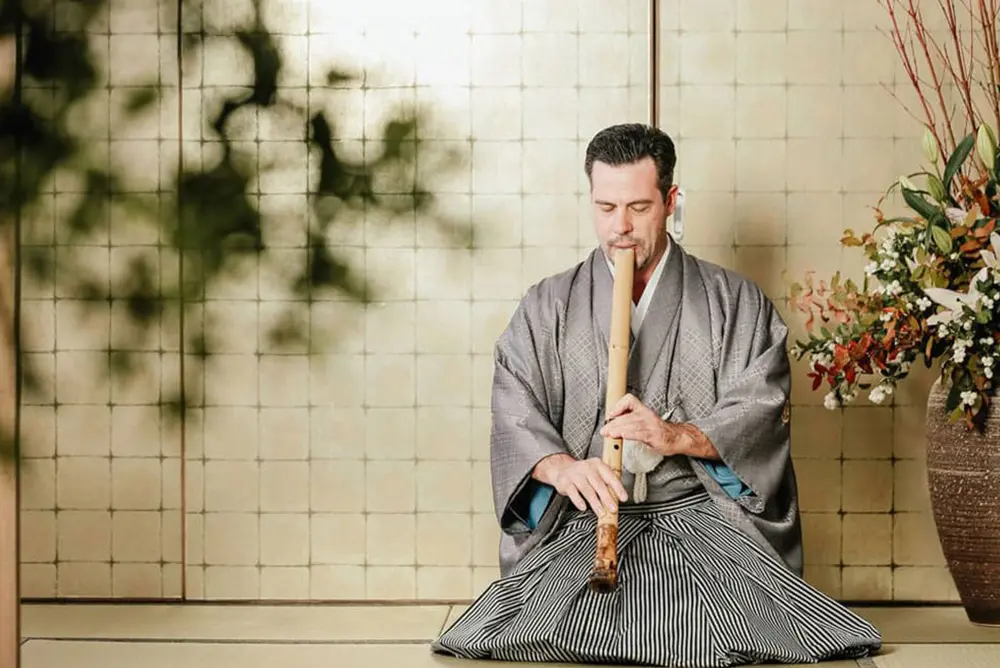
01 Jan Resonance, Balance, Power: The Defining Traits of a True Chikushin Instrument
A traditional Japanese shakuhachi achieves resonance, balance, and power only through disciplined lineage training and uncompromising craftsmanship.
By Shawn Schroeder
From my earliest years studying under Bill Shozan Schultz and later through rigorous training in Japan with masters such as Kaoru Kakizakai, Kazushi Matama, Teruo Furuya, and Akikazu Nakamura, one truth has remained constant: a shakuhachi’s voice is born of its craftsmanship’s integrity. At Chikushin Shakuhachi, every instrument reflects this lineage. Resonance, balance, and power are not marketing terms but measurable qualities shaped through careful material selection, bore design, and traditional methods that have guided generations of Japanese makers.
Resonance Shaped Through Traditional Bore Work
Resonance begins within the heart of the flute: the bore. In both jiari and jinashi instruments, the shaping of internal acoustics determines whether a shakuhachi will speak clearly or struggle with inconsistency.
Jiari Resonance
In jiari shakuhachi, a refined layer of ji is used to sculpt resonance points with precision. This process allows the maker to standardize dimensions, enhance tonal clarity, and produce instruments with a stable and powerful voice across the octaves. The ji process, shaped by urushi lacquer and tonoko powder, is shaved and tuned by hand to achieve smoothness, pitch stability, and a characteristically bright and clear tone.
Jinashi Resonance
A jinashi shakuhachi draws its resonance from the natural shape of the bamboo itself. Subtle, careful removal of material reveals the flute’s inherent voice without imposing artificial uniformity. When tuned with respect for its natural curvature and density, a jinashi instrument can produce an open, earthy, and highly expressive resonance that honors the meditative roots of the komuso tradition.
Balance in Tone, Pitch, and Responsiveness
A truly balanced shakuhachi plays with coherence across registers. The tonal color of otsu and kan, the alignment of the first and second octave, and the even responsiveness of each hole all reflect the maker’s dedication to detail.
In jiari flutes, this balance comes from the interplay between refined bore shaping and meticulous spot tuning. As the bore approaches its final dimensions, pressure points are adjusted to harmonize tone color, pitch, and playability.
In jinashi flutes, balance emerges from restraint. The maker must reveal, not impose. By tuning with sensitivity to the bamboo’s natural tendencies, the flute maintains organic tonal variation while still offering reliable pitch and fluid transitions.
Across both styles, balance remains one of the clearest indicators of authentic craftsmanship and lineage-informed training.
Power and Projection Through Skilled Bore Tuning
Power is not forcefulness. It is clarity, stability, and the ability for the flute to project with minimal effort. Achieving this requires intimate familiarity with bore acoustics.
My approach to bore tuning is guided by the methods learned from master makers such as Shingo Kimura, John Kaizan Neptune, and Katashi Ishikawa. Over the years, I moved from rigid measurement systems to a more intuitive style grounded in listening, adjusting, and letting the flute reveal where it needs space or resistance. Each note is tested across octaves, and minute adjustments refine the instrument’s dynamic range and projection.
A powerful shakuhachi should feel alive in the hands, producing sound with ease and holding its center even under strong breath.
The Role of Madake Bamboo Quality, Harvesting, and Curing
Every Chikushin instrument begins with high-quality madake bamboo harvested in Japan. Madake suited for shakuhachi is difficult to obtain and must be selected with attention to node spacing, curvature, density, and natural coloration. During my travels to Kumamoto and Osaka, I have harvested and prepared bamboo using traditional methods: aburanuki oil extraction over charcoal, long-term sun bleaching, and multi-year curing.
Properly prepared bamboo offers strength, stability, and a tonal clarity that cannot be replicated with shortcuts. Without this foundation, neither resonance, balance, nor power can develop fully.
Utaguchi Craftsmanship and Its Influence on Tone
The utaguchi is the instrument’s voice box. Its angle, depth, and inlay must be precisely shaped to guide airflow. At Chikushin, each utaguchi is carved by hand using traditional Japanese tools, with careful attention to style and lineage requirements. The resulting articulation, attack, and tonal clarity allow the player to express subtle phrasing with confidence.
Structural Integrity Through Nakatsugi Precision and Traditional Bindings
A well-crafted nakatsugi joint is essential for both structural reliability and acoustical continuity. I use techniques learned in Japan to ensure joint precision within fractions of a millimeter, employing rattan bindings or handmade silver rings sealed with lacquer. These methods produce instruments capable of enduring for decades while maintaining seamless tonal transitions between sections.
Jiari and Jinashi as Expressions of Craft and Philosophy
Jiari and jinashi instruments represent two distinct but complementary philosophies. Jiari flutes embody refinement, projection, and structural precision informed by schools such as Kinko and Tozan. Jinashi flutes, by contrast, reflect humility before the bamboo, preserving its natural voice as closely as possible.
Both traditions guide Chikushin aesthetics. Both honor the centuries of craft passed through lineages. And both address the concerns of modern players seeking reliability, authenticity, and an instrument whose voice they can trust.
Conclusion
A true Chikushin shakuhachi is the result of disciplined lineage training, traditional Japanese craftsmanship, and a lifelong commitment to understanding both the physical and spiritual dimensions of the instrument. Resonance, balance, and power do not appear by accident. They arise from careful harvesting, seasoned intuition, and a dedication to honoring the bamboo and the traditions entrusted to me.
Shawn Schroeder is a highly respected Shakuhachi craftsman and performer whose lifelong devotion to the instrument began in his youth and deepened through rigorous study with some of the world’s foremost masters. Since 2005, he has trained extensively under Bill Shozan Schultz, Kaoru Kakizakai, and other leading KSK teachers, including Kazushi Matama, Teruo Furuya, and Akikazu Nakamura, while traveling frequently to Japan to refine both his playing and his craftsmanship. Guided by the mentorship of renowned makers including John Kaizan Neptune, Shingo Kimura, and Katashi Ishikawa, Shawn has mastered traditional Japanese techniques for crafting professional Jiari and Jinashi Shakuhachi of the highest quality. Upholding the integrity of centuries-old practices while carrying forward the lineage of knowledge generously shared with him, Shawn is recognized for blending uncompromising authenticity with artistry, ensuring each instrument embodies both technical precision and spiritual depth.